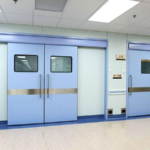
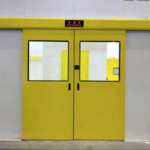
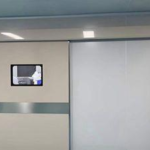
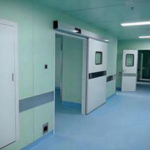
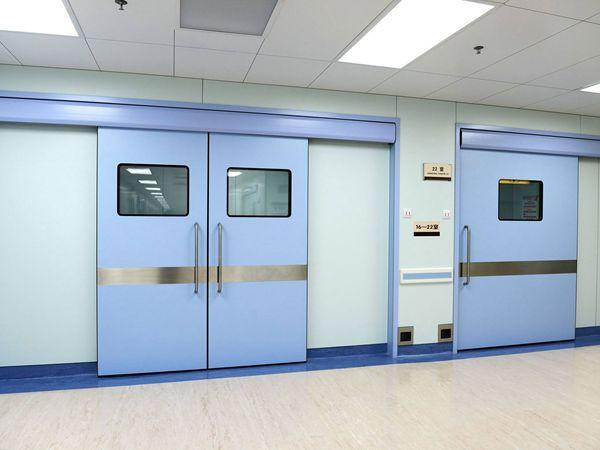
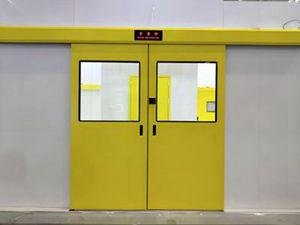
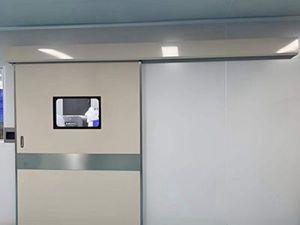
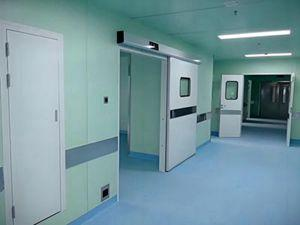
Airtightness: Professional airtight strips are installed around the door body, using unique pressing technology to ensure a tight fit with the door frame when closed, achieving reliable airtightness. The airtightness meets the highest level 8 of GBT7106-2008.
Safety features: Equipped with foot control switches and dedicated handles; during power outages, the special handle can be used, and a very small push or pull force can open the door. Safety sensors can be selected to effectively prevent pinch and can also be set as a driver sensor for the slave chamber
Internal automatic door opening; It is operated via remote control, making it simple and convenient.
Energy-saving performance: Reduces heat loss, minimizes dust intrusion, increases sealing, and saves energy.
Easy to clean and disinfect: The surface is smooth and seamless. The door body is made using large platform molds for integrated pressing, with the interior filled with rigid polyurethane high-pressure foam, and filled with a high density of 70KG/m (three times the packing density of refrigerators), ensuring high flatness
Strength and insulation performance, easy to clean, meeting hospital usage requirements.
Structural materials
Door frame: usually made of special aluminum alloy (wall thickness greater than 1.5mm) wrapped in 1.2mm 304 stainless steel wired panels in its natural color, or 304 or 316L stainless steel.
Door leaf: The panel material is 1mm high-quality galvanized steel plate, with a matte finish of powder coating (color according to user requirements). The door body thickness is 40mm, with observation window dimensions as per user requirements. Both sides of the door are edged with 1.2mm 304 stainless steel brushed panels for decoration
304 stainless steel anti-collision strip, with imported gray sealing strips embedded at the bottom, forming the same sealing plane as the three-frame sealing strip of the door frame.
Sealing strip: made of silicone, hardness 60~70, ambient temperature adaptability -30°C to 50°C, air-filled sealing strip filling and deflating test: inflation pressure 2.0kg (cm~3.0kg/cm), inflation time <5 seconds, deflation time ≤5
seconds, repeated more than 5000 times, with no explosion or gas leakage.
Hardware accessories: Equipped with stainless steel handle locks (double-leaf doors come with a false lock), double-leaf door fixed sashes have stainless steel latches at the top and bottom, each door body is equipped with at least three stainless steel hinges, each hinged thickness not less than 3mm.
Verification of key installation points; Base reinforcement: embedded galvanized steel plates (thickness ≥2mm) for brick-concrete structure walls, and installation of connecting corner panels (spacing s600mm) on light steel keel walls. Depth ≥120mm) post-filled epoxy resin glue, anchoring force ≥20kN. Sealing: NdFeB magnetic strip (magnetic energy product ≥ 45MGOe), gap with door frame ≤ 2mm, suction force ≥50N.
Pre-installation preparation: Material and tool acceptance. Core materials include door frame (stainless steel/steel), sealing strips (EPDM/silicone), hinges (stainless steel/galvanized), door closers (hydraulic/magnetic). Specialized tools include laser leveling
Instruments (accuracy ±1mm/m), welding machines (oxy-arc welding, laser rangefinders, torque wrenches (accuracy ±5%). Door opening treatment, dimensional calibration: verticality error ≤2mm/2m, levelness error 51.5mm, laser leveling
Door frame installation; Positioning and fixing, reference line; According to the design drawings, the door frame centerline, horizontal line, and completion line are displayed, with errors controlled within ±3mm, and vertical correction is required; Use a pull-out wedge for temporary fixation, and a suspension hammer to check the vertical position
Adjust the anchor bolts when the error > 2mm. Connection method: Brick wall structure: expansion bolts (M10x100) spaced s500mm, welded auxiliary angle steel (3mm thick) to enhance rigidity; concrete structure: rebar (012 rebar).
Door leaf and hardware installation; Hinges and ground axis are rotated and positioned accordingly; Of the three-leaf chain chain, two are fixed to the door frame, and one is connected to the door leaf. Preload torque 8-10N:m. Ground axis calibration: The deviation between the center of the ground axis bearing and the vertical line of the top shaft
1mm, filled with C40 fine aggregate concrete (cured for 7 days). Sealing system, inflatable sealing strip: dual airbag structure (inflation pressure 0.05-0.1MPa), post-installation compression rate = 30%, leakage rate ≤1×10-Pa·m%/s, magnetic tightness
Debugging and Function Verification: Operating parameter settings, speed adjustment: door opening speed 0.3-0.5m/s, door closing speed 0.1-0.3m/s, buffer time 2 seconds (anti-pinch pull). Interlock mechanism: dual-door interlock delay 0.5-2 seconds, air pressure
Automatic lock when a ≥ difference of 50Pa is required. Airtightness and negative pressure testing: Apply -50Pa pressure to the door gap, air leakage s1.5m2h·m (meets GBT7106 standards); Smoke test: Smoke emission 50g/m, no around the door body
Smoke leaked out.
Acceptance and Maintenance: Acceptance standards, functionality: 5,000 open/close cycles without jamming, emergency opening time of 3 seconds (manual pressure relief valve) Durability: After 480 hours of salt spray test, surface resistance changes by 10%, magnetic attraction attenuation
s20%。 Maintenance key points: Lubrication cycle: apply lithium-based grease (NLGI grade 2) to hinges every 3 months, check and air the sealing strips every six months; System testing: Annual airtightness retesting and control system upgrades.